



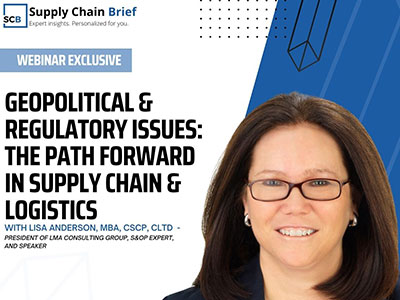
Global supply chains have become increasingly complex over the last several decades. What was once a relatively straightforward network of customers, suppliers, manufacturers, and distributors has evolved into a highly interconnected ecosystem spanning multiple countries, transportation modes, regulatory environments, and geopolitical risks.
During a recent webinar for Supply Chain Brief, we explored the geopolitical and regulatory issues reshaping supply chains and discussed practical strategies organizations can use to navigate uncertainty while positioning themselves for future success. While the challenges are significant, so are the opportunities. Companies that proactively prepare for change will be well positioned to outperform competitors and capitalize on emerging market opportunities.
Originally published on Supply Chain Brief on 6/13/2023.
Supply Chains Are More Connected Than Ever
One of the most important lessons from recent disruptions is that organizations must understand their end-to-end supply chains. Many companies have visibility into their direct suppliers but know far less about their suppliers’ suppliers or the broader network supporting critical products and materials. Yet disruptions often occur several tiers deep within the supply chain. Whether caused by geopolitical conflicts, natural resource shortages, transportation bottlenecks, or regulatory changes, vulnerabilities can emerge anywhere within the network. Organizations that develop greater visibility and understand potential points of failure are far better prepared to respond when disruptions occur.
Geopolitical Risks Continue to Grow
Geopolitics now plays a central role in supply chain strategy. Tensions between China and Taiwan remain a major concern due to Taiwan’s critical role in advanced semiconductor production. The Russia-Ukraine conflict continues to affect energy markets, commodities, fertilizer, food supplies, and industrial materials used throughout global manufacturing. At the same time, growing concerns surrounding rare earth minerals, pharmaceutical ingredients, critical infrastructure, and strategic manufacturing capabilities have elevated supply chain security to a national priority in many countries. Organizations can no longer assume uninterrupted access to critical materials and components. Supply chain resiliency now requires a deeper understanding of geopolitical developments and their potential business impact.
Natural Resources Are Becoming Strategic Assets
Supply chain discussions increasingly include topics that were once considered outside the scope of operations management. Water availability, energy infrastructure, rare earth minerals, copper, lithium, and other critical resources are becoming strategic considerations. As demand for advanced technologies, electric vehicles, artificial intelligence, and digital infrastructure continues to grow, competition for these resources will intensify. Forward-thinking organizations are evaluating how resource availability could affect long-term supply continuity, production capacity, and growth opportunities.
Regulatory Complexity Is Reshaping Logistics
The transportation and logistics sectors continue to face significant regulatory changes. Environmental regulations, emissions requirements, vehicle mandates, and infrastructure challenges are creating new pressures throughout transportation networks. While many organizations support environmental improvements and sustainability initiatives, implementation timelines and technology readiness remain major concerns.
The challenge is balancing environmental objectives with practical operational realities. Organizations must continue serving customers while adapting to changing regulatory requirements and evolving transportation capabilities. As a result, logistics strategies are changing. Companies are reassessing transportation networks, warehouse locations, port utilization, and distribution models to improve flexibility and reduce risk.
Reshoring and Regional Supply Chains Gain Momentum
One of the most significant trends emerging from recent disruptions is the movement toward reshoring, nearshoring, friendshoring, and regional supply chains. Companies are reevaluating sourcing decisions that were once driven primarily by labor costs. Today, supply chain resiliency, transportation risk, customer responsiveness, and geopolitical considerations are playing a much larger role in strategic decision-making. Organizations are increasingly looking to diversify suppliers, establish backup sources of supply, and position production closer to customers. While global supply chains will remain important, many companies are seeking a better balance between efficiency and resiliency.
Proactive Planning Creates Competitive Advantage
The organizations achieving the greatest success are not waiting for disruptions to occur. They are proactively evaluating risks, identifying opportunities, and building capabilities that allow them to adapt quickly. One of the most effective approaches is SIOP (Sales Inventory Operations Planning). SIOP provides a structured process for aligning customer demand, operational capabilities, inventory strategies, supply chain requirements, and financial objectives. Rather than reacting to events after they occur, companies can evaluate scenarios, anticipate changing conditions, and make informed decisions that improve service, profitability, and cash flow. In today’s environment, predictability is becoming just as important as resiliency.
Opportunities Will Favor the Prepared
Although geopolitical tensions, regulatory changes, resource constraints, and supply chain disruptions create significant challenges, they also create extraordinary opportunities. Organizations that invest in visibility, resiliency, talent, technology, and predictive planning will be better positioned to capture market share, strengthen customer relationships, and drive profitable growth. History has shown that periods of disruption often create opportunities for companies willing to think differently and act decisively. The same is true today. The future belongs to organizations that proactively prepare for change, build resilient supply chains, and create the agility needed to thrive in an increasingly complex world.