




If you don’t have a modern ERP system that will support your business growth and changing customer requirements that also supports your ability to scale profitability and with greater levels of automation and predictive analytics, you need an upgraded ERP system YESTERDAY! Just a few years ago, we could confidently tell clients that although they didn’t have a modern ERP system, they could better utilize what they had and make significant progress; however, it is no longer enough.
To thrive post-pandemic, you’ll need advanced functionality that can support evolving business requirements. There is no time to wait for critical customer information and key data for decision-making. Instead, you’ll need a modern ERP system that supports customer requirements, SIOP (sales, inventory, and operations planning) models, predictive analytics and more. I recently talked with CIO magazine about selecting and implementing an ERP system. I’d love your feedback and insights on this topic.
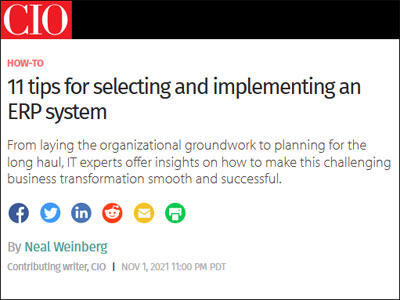
What Should We Consider and/or What Impacts Could Arise?
Start by performing a systems assessment. Many clients that think they need a new ERP system simply need to upgrade processes and roll out additional functionality already existing in their system or functionality that can be added easily. With that said, in the post-COVID era, keeping up with improvements and potential supply chain disruptions is of paramount importance. Thus, upgrading to a modern ERP system and/or better utilizing ERP functionality is a likely outcome. Automating what makes sense and utilizing AI-enabled functionality to provide superior customer service, enhance profitability and accelerate working capital are keys to success.
Did you like this article? Continue reading on this topic:
ERP as the Backbone of Supply Chain