



Planning creates alignment. Execution delivers results.
Manufacturers and distributors invest significant time and resources in forecasting demand, balancing supply with demand through SIOP (Sales, Inventory & Operations Planning), and developing supply chain strategies. Yet even the best plans create little value if they cannot be executed consistently. Customer service is won or lost in execution.
Products must be manufactured efficiently, warehouse operations must fulfill orders accurately, labor must be aligned with production requirements, and shipments must arrive on time. As organizations navigate labor shortages, geopolitical uncertainty, tariff volatility, supply chain disruptions, and rising customer expectations, execution has become a strategic differentiator.
Organizations with connected execution capabilities respond more quickly to change, solve problems proactively, and consistently deliver superior customer experiences. Execution and fulfillment systems provide the visibility and operational control needed to enhance customer service, strengthen operational performance, and support profitable growth.
Table of Contents
- Why Execution Matters
- Connecting Planning with Execution
- Building Execution Excellence
- Execution Excellence in Action
- Improving Quality Through Real-Time Manufacturing Visibility
- Optimizing Transportation While Reducing Freight Costs
- Increasing Warehouse Productivity
- Optimizing Labor Scheduling and Workforce Performance
- The Future of Execution: Connected Supply Chains
- Positioning Your Organization for Success
Why Execution Matters
Today’s manufacturers and distributors operate in an increasingly dynamic environment. Supplier delays, labor shortages, supply chain disruptions, equipment failures, changing customer demand, and geopolitical uncertainty require organizations to respond quickly while maintaining high levels of customer service. Without connected execution capabilities, small operational issues quickly become larger business problems. Supplier shortages reduce productivity and increase overtime. Production delays lead to missed shipments. Warehouse bottlenecks slow fulfillment. Transportation disruptions increase freight costs.
Forward-thinking organizations approach execution differently. They combine disciplined business processes with real-time operational visibility, allowing them to identify issues early, make informed decisions quickly, and continuously improve performance. The result is stronger customer service, better operational performance, greater resilience, and improved bottom line results.
Connecting Planning with Execution
Planning and execution are complementary business capabilities. SIOP aligns demand, supply, inventory, capacity, and financial objectives across the organization. Execution systems ensure those plans are carried out while providing immediate visibility whenever operating conditions change.
For example, production and material delays, operational bottlenecks, transportation disruptions, inventory shortages, or labor constraints can quickly ripple throughout the supply chain. Connected execution systems allow organizations to identify these issues early, adjust production schedules, rebalance inventory, optimize transportation, and communicate proactively before customer service suffers. Execution also strengthens planning. Manufacturing performance, warehouse productivity, transportation costs, inventory accuracy, labor utilization, and customer service metrics continuously provide feedback to improve forecasting, inventory planning, and capacity planning. Organizations that integrate planning with execution become significantly more agile and resilient.
Building Execution Excellence
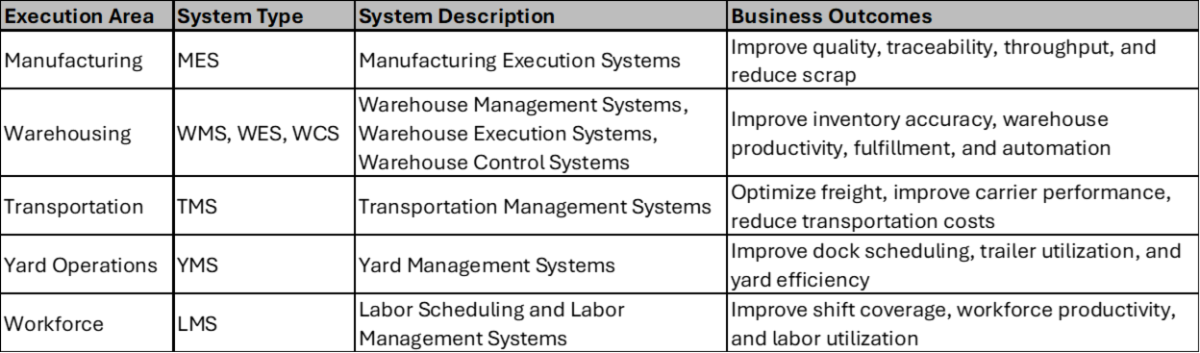
Increasingly, these systems leverage artificial intelligence, robotics, machine vision, Internet of Things (IoT) sensors, predictive analytics, and automation to improve decision-making across manufacturing, warehousing, transportation, and customer fulfillment. The greatest value is achieved when execution technologies are integrated with ERP systems, planning processes, and one another to create end-to-end visibility across the supply chain.
Execution Excellence in Action
Technology creates value when it supports business strategy, standardized processes, and better decision-making. The following client examples demonstrate how execution systems improve customer service, operational performance, and profitability.
Improving Quality Through Real-Time Manufacturing Visibility
A healthcare products manufacturer implemented manufacturing execution system (MES) capabilities to improve both quality and manufacturing performance. Rather than relying primarily on end-of-line inspections, the company integrated machine vision technology with its MES solution to identify potential quality issues as products moved through production. Cameras detected abnormalities in real time, allowing operators to address process variations before defective products continued downstream.
The MES system also provided greater visibility into production performance, helping reduce scrap, optimize manufacturing efficiency, and improve throughput. Instead of finding quality issues after production was complete, the manufacturer prevented defects before they occurred, thereby improving customer satisfaction while lowering operating costs.
Optimizing Transportation While Reducing Freight Costs
An absorbent products manufacturer implemented a transportation management system (TMS) to improve transportation routes and freight execution to its customers. The solution optimized transportation routes and designed efficient multi-stop truckloads that maximized trailer utilization while ensuring customers received products on time Customer commit date reliability improved. Stable transportation lanes combined with dynamic optimization of loads not only strengthened carrier relationships, improving service reliability and delivery consistency but it also reduced costs. Improved route optimization also reduced unnecessary miles, lowering fuel consumption and the company’s environmental footprint. The results were substantial. Freight costs declined by approximately 20 percent—more than offsetting rising fuel prices—while simultaneously improving transportation reliability, customer service, and operational performance.
Increasing Warehouse Productivity
A consumer products manufacturer enhanced its warehouse management system (WMS) to improve warehouse execution and fulfillment performance. By redesigning warehouse flow and optimizing picking routes, the organization significantly reduced unnecessary travel time for warehouse associates while streamlining order fulfillment.
The improvements reduced warehouse travel time by approximately 30 percent and increased warehouse productivity by more than 20 percent. Faster, more efficient picking improved order accuracy, shortened fulfillment lead times, and increased warehouse capacity without requiring additional labor or warehouse expansion. The project demonstrated how relatively small improvements in warehouse execution can generate meaningful gains in productivity, customer service, and profitability.
Optimizing Labor Scheduling and Workforce Performance
A food and beverage manufacturer sought to improve workforce utilization while ensuring adequate staffing to support changing production requirements. Traditional scheduling methods required significant manual effort and often resulted in overtime, inconsistent shift coverage, and unnecessary administrative work. The company implemented a labor management system (LMS) with labor scheduling capabilities that leveraged robust data intelligence and tailored automation to create adaptive, worker-friendly schedules. The system aligned labor availability with production requirements while maximizing shift coverage and improving workforce flexibility.
By improving labor planning and scheduling, the manufacturer reduced administrative effort, increased operational responsiveness, and better aligned labor resources with customer demand. The result was improved operational performance while creating a more consistent and employee-friendly scheduling process.
The Future of Execution: Connected Supply Chains
Execution systems are evolving beyond managing individual manufacturing plants, warehouses, or transportation networks. Leading organizations are creating connected operations where machines, employees, suppliers, and customers share real-time information to improve decision-making across the supply chain. Artificial intelligence, robotics, machine vision, Internet of Things (IoT) sensors, predictive analytics, and digital twins enable organizations to anticipate issues rather than simply react to them.
An industrial bearing distributor demonstrated this evolution through a vendor-managed inventory (VMI) program supported by connected manufacturing technologies. By connecting with their customers’ manufacturing execution systems and connected factory environments, the distributor gained visibility into equipment performance using sensor data and digital twin technology. Rather than waiting for equipment failures, the distributor analyzed machine conditions to predict when bearings would require replacement. Inventory was replenished proactively before failures occurred, minimizing downtime while extending equipment life. By connecting suppliers, manufacturers, and operational data across the supply chain, the distributor strengthened customer relationships while helping customers improve operational reliability.
Connected factories represent the next evolution of execution excellence. As organizations share more operational data across suppliers, logistics providers, manufacturing operations, and customers, they will improve responsiveness, strengthen resilience, optimize inventory, and create greater value throughout the supply chain.
Positioning Your Organization for Success
Execution excellence has become a competitive advantage. Organizations that integrate planning, people, processes, and technology consistently deliver higher levels of customer service, stronger operational performance, and more resilient supply chains. They reduce costs, improve responsiveness, and create the agility needed to adapt to changing customer requirements and market conditions.
Execution and fulfillment systems are not simply technology investments—they are business capabilities that enable organizations to consistently deliver customer service and operational performance. As artificial intelligence, automation, and connected manufacturing continue to advance, organizations that successfully integrate these capabilities will be best positioned to achieve sustainable, profitable growth while delivering superior customer value.
If you are interested in reading more on this topic:
Supply Chain Visibility Fueling Faster, Smarter & Proactive Decision-Making