



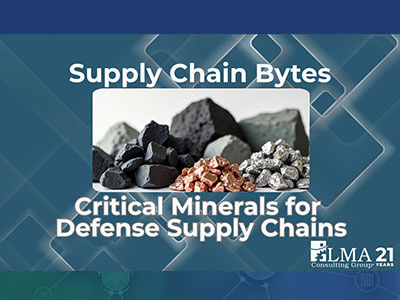
Critical minerals are becoming an even greater priority for defense supply chains. In this Supply Chain Byte, Lisa Anderson discusses the recent executive order tightening restrictions on sourcing critical materials from China, Russia, Iran and North Korea, with significant new provisions taking effect beginning January 1, 2027.
Manufacturers and defense-related suppliers will need to pay even closer attention to where critical minerals and materials originate. The key is visibility across the end-to-end supply chain. Manufacturers must understand not only their direct suppliers, but also their Tier 2, Tier 3 and even Tier 4 suppliers to ensure they can support customer requirements, reduce risk and prepare for future business growth.
Critical minerals have been an important topic as the U.S. remains heavily dependent on China. China accounts for roughly 70% of global rare-earth mining and dominates the processing of many critical minerals. Its control exceeds 80% for several minerals essential to defense and national security and reaches 99% of global production for gallium, a critical input for advanced electronics and defense technologies.
Trump issued an executive order in April 2025 that directed the Commerce Department to perform a study. In October 2025, the study was completed and showed that U.S. imports of processed critical minerals and derivative products threatened national security. Thus, Trump directed Commerce and USTR to negotiate agreements with trading partners aimed at securing supply and reducing U.S. dependence on vulnerable foreign sources.
The July executive order directs the Department of Defense to develop specific requirements that prime contractors and subcontractors will have to meet, and it directs Defense to develop implementing policy and regulations. It provides timeframes to ramp up and requires the following:
- Mapping the entire critical supply chain.
- Contractors to assess supplier risk.
- Action where vulnerabilities are found.
- Qualifying alternative sources to unreliable foreign suppliers.
- Makes waivers much harder.
Importantly, the July executive order goes beyond critical minerals and foreign sourcing to address fundamental supply chain risks. It specifically identifies capacity constraints, production delays, disrupted material deliveries, limited ability to surge production, sole-source dependencies, and overreliance on a single supplier. Looking at Tier 1, or even Tier 2, suppliers is no longer sufficient. A domestic supplier can still represent a significant vulnerability if it lacks capacity, cannot rapidly increase production, or represents a single point of failure. Manufacturers should look across multiple tiers of the supply chain to identify capacity constraints, supplier concentration, long lead times, and sole-source dependencies that could put revenue and customer commitments at risk — and develop alternate sources, additional capacity, and other mitigation strategies before disruption occurs.
U.S. supply chains will have to evolve and scale rapidly over the next several years to build domestic and allied capabilities, strengthen resilience, and support customer growth. Learn more about supply chain network strategy and optimization strategies in our article.
If you are interested in reading more on this topic:
Project Vault