



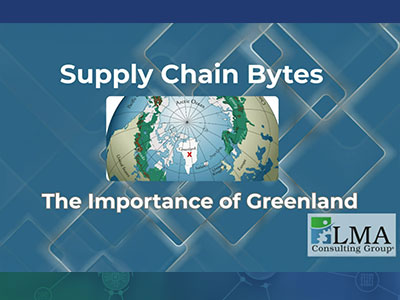
Greenland is a strategic focal point in global supply chains. In this Supply Chain Byte, Lisa Anderson discusses three reasons why Greenland matters to supply chains: shipping routes, defense and the Golden Dome and rare earth elements. She also shares what manufacturers should be thinking about now as global priorities continue to shift. Gain additional insights in our article, “Why is Greenland Strategic to the Global Supply Chain & Defense“.
Aside from politics and debate, Greenland is strategic to the global supply chain. Since the ice has been melting in the Arctic region, there are two potential shipping routes emerging. The Northwest Passage which goes through Canadian Arctic waters, and the Transpolar Sea Route which has great potential as a future shipping lane as it avoids Russian and Canadian coastal control both shorten routes from Asia to North America. These potential routes certainly have their fair share of challenges remaining to make them viable; however, they would avoid key chokepoints in the global supply chain such as the Suez Canal and the Panama Canal.
Greenland is also a strategic location for defense. Since the U.S. wants to deploy a Golden Dome, a layered air and missile defense shield and the shortest and most likely missiles path flies directly over Greenland, it defaults to a strategic location. Thus, this location is essential in providing early warning signals, modernizing and expanding defense technology, and it becomes even more relevant as fast speed hypersonic missiles are gaining momentum.
Last but not least, Greenland is a strategic location as it has one of the largest undeveloped rare earth element reserves in the world outside of China. Rare earths are required for critical items such as artificial intelligence, defense, medical devices, and automobiles. Since China dominates rare earth mining and refining and is willing to cut off access to the world (as occurred in 2025), Greenland opens up opportunities to diversify risk from China. To learn more about the importance of rare earth minerals, refer to our article, “Only as Strong as Your Weakest Link in the Supply Chain: The Rare Earth Threat“
What should you take away from the Greenland debate no matter your place in the supply chain?
Smart executives are rethinking and reshaping supply chains in real time. The key is to think creatively and be forward-thinking and innovative. For your company and end-to-end supply chain, which materials, components, and/or relationships require access vs greater control vs ownership? For non-critical items, the typical supplier relationship with a focus on cost and availability is likely the smartest course of action. On the other hand, if your company will go to a grinding halt with your differentiating advantage with your customers, you might need ownership. There is plenty of space in the middle. In addition, key factors to consider when assessing this situation include the ability to scale rapidly to capture opportunities, expand capabilities, and modernize with new technologies and attributes such as the hypersonic missile.
For example, a mid-market manufacturer had three tiers of performance on their core product line, adult diapers. Their best performing product utilized a proprietary material that enabled greater absorption at a reasonable cost. There is no way they would outsource this capability to anyone other than a strategic partner supplier. On a new product line they thought would support future customer needs, they wanted to start quickly, scale up rapidly and get into that marketplace before they lost their opportunity. Thus, although they saw it as core to the future, they started with a joint venture relationship to gain additional control yet not full control as they valued speed over control. After they gained expertise and market position, they purchased new equipment and ramped up domestic production of the new product line. On the other hand, they utilized a price / quality strategy without a focus on control for several raw materials that were in abundant supply with domestic and global suppliers.
Did you like this article? Continue reading on this topic:
Medical Products Driving Mining, Manufacturing and Construction