



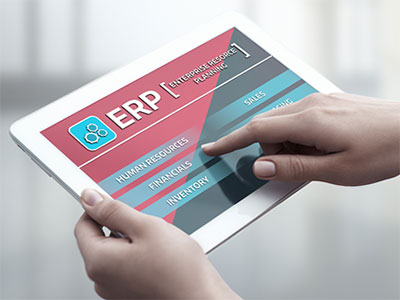
Supply chain transformations and upgrades require the improved use of ERP. There is no doubt about it – ERP is the backbone of supply chain performance. Clients come to us to improve performance (typically profitable growth, customer service, and cash flow), and the better utilization of ERP was a key part of 100% of these clients and was required to deliver bottom line results. ERP and related technologies including artificial intelligence (typically embedded in ERP and/or provided with peripheral systems) are cornerstone to creating predictability, serviceability, resiliency, scalability, sustainability (ensuring clients can maintain progress) and profitability.
ERP Underpins Supply Chain Upgrades
There are countless ways to utilize ERP to support supply chain effectiveness. Refer to our capstone article, “ERP Utilization: Automate, Digitize, and Scale” for examples from managing prospective customers to the order fulfillment process inclusive of planning, purchasing, operations, and logistics. ERP and supply chain go hand-in-hand for every potential client interested in growth, service, and automation. We’ll discuss common situations and how they relate back to utilizing ERP.
- Interested in turning potential customers, projects or orders into firm customer orders?
Our best clients utilize CRM (customer relationship management) functionality to track the sales pipeline, organize accounts and contacts, provide intelligent insights for customer/ prospective customer meetings, track sales and customer activity, monitor opportunities and quotes, and gain business intelligence and predictive analytics information for growing the business and serving customers.
- Struggling to configure products rapidly to support customer needs?
Configure price quote (CPQ) system functionality supports the rapid configuration of products and prices to support customer requests while better communicating upcoming needs to engineering, planning, purchasing, operations, and supply chain functions. Custom manufacturers that utilize CPQ are dramatically more responsive and shorten lead times significantly vs the competition.
- Do you want to automate big pricing books to improve accuracy & save time?
In addition to CPQ functionality for custom manufacturers (as pricing becomes a complex puzzle with hundreds of lists and spreadsheets otherwise), ERP pricing modules are essential in replacing big books of price sheets. They will incorporate standard price lists (which often sound far simpler to rollout than reality), customer or channel specific pricing, quantity breaks, discounts, and promotions, etc. Multiple clients went from the infamous price book and guru to utilizing ERP functionality to accelerate, improve, and scale.
- Frustrated in having real time access to answers when customers contact you?
There are several areas of ERP functionality that support Customer Service and arm these resources with real time information to proactively communicate with customers and respond to inquiries. Customer portals, order management functionality, order status visibility, and inventory availability functionality provide critical answers. For example, available to promise (ATP) functionality provides insight upfront on whether you can commit to a customer order, how much you can commit, and when you can deliver it based on current and expected supply. Order management functionality, order status visibility, and inventory availability functionality.
- Struggling with past due or extended lead times?
ERP is integral to resolving past due issues and shortening lead times as these issues relate back to several core ERP functionality topics. From demand and order related functionality (CRM, CPQ, sales forecasting, order management, pricing, ATP) to planning (MPS, MRP, DRP), purchasing, operations (CRP, boms, routings, work centers, inventory, MES), shipping, receiving, warehousing, and returns, the solution always involves the use of ERP. Artificial intelligence and advanced technologies also are integral as inventory availability, dynamic optimization, and predictive insights are key to success.
- Interested in improving operational visibility and performance?
To improve operational performance, you need proactive planning systems (MPS, MRP, DRP), optimized production schedules, clear capacity and labor plans (CRP), operational readiness (boms, routings, work centers, MES), material supply (relates back to planning and purchasing systems), and a clear view of priorities (order status, customer priorities, service policies, shipping schedules), reporting (BI) etc.
- Is outside processing a bottleneck?
In almost every client that requires outside processing (such as powder coating, anodizing, etc.), it is a bottleneck. ERP functionality can assist, at a minimum automate and improve visibility, as outside processing involves purchase orders, work orders, tying the two together, order status, etc.
- You want to get Sales and Operations on the same page?
ERP is cornerstone to the SIOP (Sales Inventory Operations Planning) process to align demand with supply and get Sales and Operations singing off the same sheet of music. Starting with forecasts, quotes and orders, and translating sales order demands into production and distribution plans, capacity plans and fulfillment plans, the sales order is integral to the process. These plans also result in inventory projections, cash flow forecasts, capital equipment / capital expenditure needs, pricing and product recommendations, and mix and lead time impacts.
- Struggling to ensure customer and margin success with your supply chain network?
As companies navigate shipping, import/ export, a network of distribution and/or service centers, and 3PLs, ERP functionality is key to achieving customer value while automating tasks and efficiently delivering goods to customers. For example, shipping, receiving, inventory transactions, cycle counting, order allocation, warehouse management systems (WMS), transportation management systems (TMS), and other functionality supports the efficient and effective delivery of products.
Process and ERP are intertwined. To gain additional insights on process upgrades, refer to our article, “5 Ways to Improve Processes“. Results will follow.
Supply Chain Upgrade with ERP
Since supply chain and ERP go hand-in-hand, it is imperative that you design your transformation and upgrade projects to focus on the people, process, and the use of ERP and related systems. A few best practice strategies we’ve found to yield substantial results include:
- Kick-off: Assemble the appropriate resources with a cross-functional focus related to the supply chain upgrade (inputs, outputs, and the upgrade), provide the vision/ reasoning behind the upgrade, the key milestones and/or phases, how feedback/ inputs will be incorporated, and detail specific next steps so that everyone knows what’s coming down the pike.
- Rapid assessment/ understanding of current state: Depending on the upgrade, the team should perform a rapid assessment and/ or gain an understanding of the current state, what is important to achieve results, what issues the users are experiencing, ideas for improvement, etc.
- Design the upgrade: It is essential to bring process and systems expertise together to design the upgrade collaboratively. Since it might involve customer and supplier requirements, inputs and outputs, connections between systems, step-by-step process nuances, daily work routines (involving both manual and systems steps), the use of IoT, artificial intelligence and advanced technologies, and other critical factors, the design is the 80/20 of success. We find that the people who have robust capabilities in process, systems, integration/ connections, data, and integration with hardware/ equipment and IoT devices are hard to find. Thinking three steps ahead and seeing down-the-line impacts is even harder to find. Source the appropriate ERP resources, consultants, technology resources, and other talent as needed.
- Test the upgrade: As you roll out the upgrade and utilize ERP functionality, it is important to test that the upgrade performs and achieves the outputs and results that you expect. In more than 80% of the situations, there will be tweaks and/or adjustments to incorporate into the upgrade.
- Pilot the upgrade: Piloting the process upgrade allows you to test your design with normal conditions. For example, ERP upgrades frequently work in a silo, but experience issues when other transactions are occurring and when volumes are normal. Performing a pilot allows you to incorporate these nuances while also engaging and educating the team.
- Develop & manage the implementation plan: Since rubber meets the road in execution which drives 80% of success, developing a detailed implementation plan and managing the project upgrade closely is key to success.
- Training & education: To ensure the team understands the step-by-step procedures as well as the reasoning behind the upgrade and the down-the-line impacts, training and education must be accompanied with the upgrade. Most ERP upgrades fail with training alone. The first mistake occurs, and everything comes to a halt.
Much of these recommendations refers back to strong project and program management. Thus, while rolling out your supply chain business systems upgrade, remember to stay focused on the critical path. Refer to our article, “10 Ways to Stay Focused on the Critical Path” for additional tips for success.
The Bottom Line
ERP and the supply chain must go hand-in-hand because the supply chain is the operation—and ERP is the system that makes it visible, coordinated, and executable at scale. Although you can find companies that largely function in spite of ERP and those with top tier ERP systems that don’t perform well, every successful client relies on the coordinated approach of people, processes, ERP and related technologies, and associated metrics.
Did you like this article? Continue reading on this topic:
Case Study in Fueling Productivity, Profitability, & Performance with ERP Optimization