



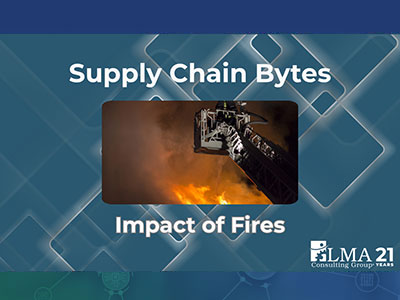
Recent fires in California are a reminder that supply chain disruptions can happen quickly – and the regional impact can be significant. In this Supply Chain Byte, Lisa Anderson discusses two recent examples: a fire affecting a medical device distribution center and another involving a cold storage facility. Both highlight why manufacturers and distributors need more than a static plan. The key is having the capability to dynamically reroute trucks, shift inventory and review the supply chain network to make sure backup plans are in place before disruption occurs.
California Fires & Supply Chain Impacts
Medline lost its 1.1 million square foot building in Tracy, California. A fire started on the building’s solar roof panels and burned for several days. Unfortunately, the sprinkler system did not operate properly, and there was no water pressure in the fire hydrants. We needed a backup to the backup to the backup plan! Since this distribution facility was a regional medical supply warehouse, the company immediately set up a 24-hour command center to redirect the vast majority of order lines to secondary and tertiary distribution facilities within their regional and national network. In addition, they increased staffing, inventory and transportation levels across the region and utilized nearby hubs. Although the company said their supply chain is designed for resiliency, we think shortages and delays are likely once inventory runs low.
In Boyle Heights, contractors were working on solar panels on the roof when a fire broke out at a cold storage facility. This Lineage facility also burned for several days, destroying 85 million pounds of frozen food that supplies grocery stores and restaurants while also creating an environmental concern. Lineage operates 22 other facilities in Southern California, and so they will shift shipments and deliveries to accommodate. Similarly to the Tracy fire, there are likely to be impacts as inventory is worked down. At a minimum, since the facility was a critical stop for truck routes, there will be re-routing and logistical delays.
What Should We Learn
When this type of event occurs, the companies that recover fastest are those with the visibility and decision-making processes to quickly evaluate alternatives and execute a coordinated response. A robust SIOP (Sales, Inventory & Operations Planning) process provides the cross-functional framework needed to assess customer demand, available inventory, production capacity, supplier capabilities, and transportation constraints simultaneously. This enables leaders to rapidly prioritize customers, align commercial and operational decisions, communicate realistic commitments, and direct resources where they will have the greatest impact on customer service and profitability. To learn more about how to rollout SIOP, download our eBook, “SIOP: Creating Predictable Revenue and EBITDA Growth“.
Technology further accelerates these capabilities. Advanced Planning and Scheduling (APS) systems and Transportation Management Systems (TMS) can automatically reschedule production, reallocate inventory, reroute shipments, and optimize transportation plans as conditions change. Instead of relying on manual spreadsheets and disconnected decisions, these tools help identify the most effective recovery plan while balancing costs such as trucking, overtime, expedited freight, production changes, and inventory repositioning. Even without dynamic planning systems, companies should apply the same principles by establishing backup distribution locations, qualifying alternate suppliers and transportation providers, developing contingency plans, and continuously reassessing priorities as conditions evolve. Preparing these capabilities before a disruption occurs dramatically improves resilience, allowing organizations to restore operations faster while protecting both customer relationships and financial performance.
If you are interested in reading more on this topic:
Supply Chain Visibility Fueling Faster, Smarter & Proactive Decision-Making