



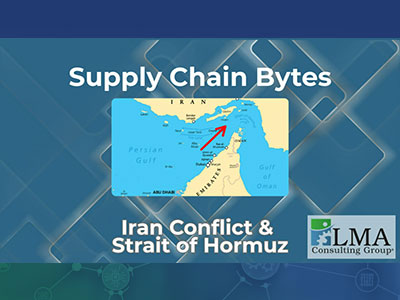
Geopolitics can quickly reshape global supply chains. In this Supply Chain Byte, Lisa Anderson explains why the Iran conflict and the Strait of Hormuz matter to manufacturers. As one of the most critical shipping chokepoints in the world, disruptions in this region can impact global trade, energy supply and transportation costs. Lisa advises what manufacturers should be thinking about now – from evaluating end-to-end supply chains to assessing risk and preparing contingency strategies.
The conflict in Iran involves coordinated military strikes by the United States and Israel against Iranian military infrastructure, nuclear facilities, and leadership. It impacted the Strait of Hormuz which is between Oman, the UAE and Saudi Arabia and Iran, making it a supply chain chokepoint especially for energy movement between Asia, Europe, Russia, and the Middle East. Twenty percent of global oil and 20% of liquified natural gas (LNG) flows through the Strait of Hormuz.
Ninety percent of sanctioned Iranian oil goes to China, and so the greatest impact will be on China as even once the Strait opens up and flows freely, Iranian oil will be negatively impacted or sold at regular pricing (not lower, sanctioned pricing). Thus, the conflict has a secondary impact on China as they get 40-50% of their oil and 30% of their LNG (from Qatar and UAE) through the Strait of Hormuz, which is required to support their manufacturing infrastructure, data center and artificial intelligence buildout, etc.
Other countries will be impacted by the Strait until it starts flowing freely. India is dependent on Qatar and the UAE for LNG imports. Japan gets 75% of its oil imports and 6% of LNG through the Strait, and Korea get 70% of its oil imports and 14% of its LNG imports through the Strait. Thus, the U.S. has extended insurance and safe passage through the Strait of Hormuz to stabilize global energy markets. Although the U.S. has plenty of energy supply, is exporting to other countries, and Venezuela is now selling oil on the open market, these disruptions cause the global oil prices to spike. Since energy is a critical component in manufacturing and logistics, it will impact every supply chain until the chokepoint stabilizes.
We expect the chokepoint to stabilize within the next several weeks; however, it points out the critical need to plan for disruptions and diversions. Companies should be focused on backup sources of supply, diversifying supply chains, moving towards regional supply chains, and advanced processes such as AI-enabled SIOP (Sales Inventory Operations Planning) to dynamically re-route and stay ahead of changing conditions to ensure customer and EBITDA success. To learn more, refer to our SIOP eBook and our AI eBook for powering supply chains and smarter decisions.
If you are interested in reading more on this topic:
The War in Iran, Supply Chain Impacts & Actions