


Investing in Regional Supply Chains
In this Supply Chain Byte, Lisa Anderson explores why regional supply chain alignment is the key to responsiveness, growth, and competitiveness.
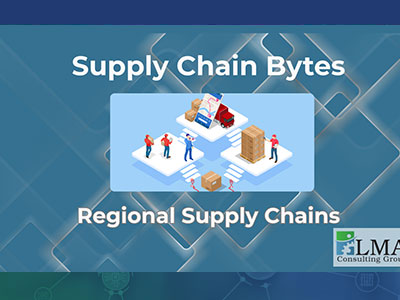
Smart proactive companies are moving supply chains from global to local - or regional at a minimum. Yet the best companies are doing that while also focusing on resiliency. Our best clients are getting ahead of the pack with proactive strategies to move towards local with resiliency.
Medical products manufacturing is gaining momentum as companies want to build resilience to mitigate risk in the supply chain. Executives have realized that they must better control their end-to-end supply chain to ensure supply as geopolitical risks, vulnerabilities, and disruptions continue to arise while tariffs also push companies to build domestic capacity.
As geopolitical, tariff, and other supply chain risks are causing concerns with offshoring strategies and the global sourcing perspective, companies are reviewing domestic alternatives. Companies are moving towards domestic and regional supply chains and preparing to scale manufacturing and the extended supply chains.
Disruptions rarely stay contained and aluminum is a clear example. In this Supply Chain Byte, Lisa Anderson explains how challenges in one material can ripple through the entire end-to-end supply chain, affecting the largest of manufacturers.
LMA Consulting Group, Inc., a leader in manufacturing strategy and supply chain transformation, led by Lisa Anderson, MBA, CSCP, CLTD, joins the national spotlight for Manufacturing Month by highlighting the renewed strength and strategic importance of U.S. manufacturing.
Listen to the discussion on what’s happening on the ground in American manufacturing, including tactical compliance moves, major capital investment announcements, and longer-term strategic shifts—or the lack thereof
The U.S.–Mexico trade relationship is one of the most critical drivers of manufacturing supply chains today. With more than $800 billion in goods crossing the border annually, companies on both sides are rethinking their strategies for sourcing, production, logistics, and growth.
In step change progress to depending on China (who has been unreliable in supplying critical minerals), a strategic partnership has been developed to replace this dependence for antibiotics. Not many companies can take over manufacturing of extended supply chains and scale up adequately. Thus, strategic partnerships can provide the resources and investments to scale and succeed.
Supply chains are evolving at a rapid pace as global risks increase. To achieve success with this transformation, companies must roll out advanced technologies and develop strategies to mitigate down-the-line risks and impacts such as access to critical minerals and energy.