


Using AI to Improve Business Performance
As business executives contend with heightened supply chain risks and inflationary pressures, artificial intelligence (AI) has emerged as a hot technology that can help to improve business performance.
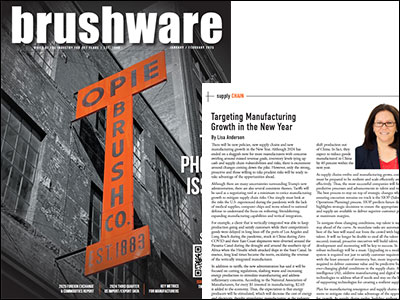
As supply chains become more complex, organizations must move beyond resiliency and efficiency toward predictability, scalability, and customer value. In this ASCM San Fernando Valley presentation, Lisa Anderson discusses the risks and opportunities shaping the future of supply chains and shares strategies for building talent, leveraging technology, implementing SIOP, and positioning organizations for long-term success.
As automation and digitization transform manufacturing, the demand for top talent has never been greater. In this Supply Chain Byte, discover why skilled professionals are essential to thriving in a high-tech future—and how to attract and retain the talent your business needs.
What does the election mean for manufacturing and supply chain? Will it be a continuation of the status quo, a surge for manufacturers, or a further dampening of the economy?
Companies can mitigate the volatility caused by labor disputes by rethinking sourcing strategies, upgrading planning processes, and using advanced technology.
Given the uncertainty of the economy creating extreme push outs and pull ins with customer orders, only those companies that can successfully deal with uncertain and changing conditions can thrive. Companies that automate, create value and digitize will drive bottom-line results.
Volatility, uncertainty, complexity, and ambiguity (VUCA) have plagued medtech’s supply chain since the pandemic. Drug shortages last year hit their highest levels in a decade, with 99% of hospital and health system pharmacists experiencing medicinal dearths, according to an American Society of Health System Pharmacists (ASHP) survey.
There has been a plethora of strikes, potential strikes and disruptions in the last few years. In fact, the threat of strikes has made its way through the supply chain.
According to the WorldMetrics.org report, 89% of manufacturers believe automation is key to increasing productivity. More importantly to increasing profitable growth, the report also finds that automation reduces manufacturing lead time by 75%.
The economy is facing headwinds with high inflation, interest rates, and concerning employment numbers. The world is on high-risk alert with the Russia Ukraine war, and the Israel Hamas war, which has expanded to Hezbollah.