


California Wildfires Create Ripple Effects on Supply Chains
Lisa Anderson was quoted on Supply Chain Dive about how the California wildfires are affecting supply chains and logistics.
KNX interviewed Lisa Anderson about the Los Angeles fires and the supply chain impacts and economic impacts. We discussed the devastation caused by the fires, how the retail supply chains would be affected from demand and supply misalignment, and the impacts on the building and construction industry as well as the consumer products industry.
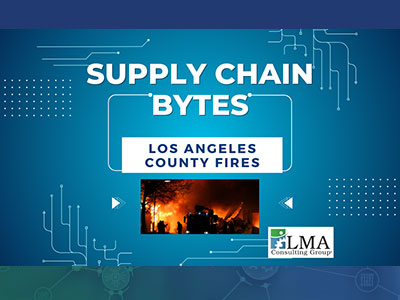
The LA County fires are leaving a lasting impact on supply chains. In this Supply Chain Byte, Lisa Anderson discusses the challenges businesses face and actionable steps companies can take to adapt and maintain resilience during this crisis.
Lisa Anderson warns that the recent devastating fires in Los Angeles County will have far-reaching impacts on supply chains well beyond the immediate area. With over 100,000 people displaced and critical infrastructure, IT systems and power grids affected, businesses across industries must prepare for disruptions that could persist for months.
According to a McKinsey study, investment in supply chain digitization is slowing down after rapid growth in 2020-2023. On the other hand, the McKinsey Global Supply Chain Leader Survey finds that nine out of 10 respondents continue to experience supply chain challenges. And, according to Reuters, supply chain glitches [...]
Although we talk about the value of the backup to the backup all the time in supply chain circles, when the rubber meets the road with the costs of the backup, it can be seen as excessive.
Consumer spending is on the rise, and it’s affecting supply chains. In this Supply Chain Byte, Lisa Anderson highlights the key factors—like logistics—you need to consider to stay prepared and keep your supply chain agile.
There will be new policies, new supply chains and new manufacturing growth in the New Year. Although 2024 has ended on a sluggish note for most manufacturers with concerns swirling around missed revenue goals, inventory levels tying up cash and supply chain vulnerabilities and risks, there is excitement around changes coming down the pike.
The peak season started two months earlier than normal and extended two months later than normal to account for the volatility and expected disruptions in the global supply chain.
Fulfilling customer demand successfully is not as easy as it was prior to this volatile, uncertain, complex, and ambiguous (VUCA) environment. As supply chain disruptions continue to rage, planners jump through hoops, expedite, and are a bit frazzled trying to support customer requirements while meeting operational objectives, pushing back when needed on sales commitments, and addressing cost concerns.